Educational Resilience: A New Paradigm of Asynchronous Learning Amidst Global Energy Crises
V. Zalizko
International Innovation Centr for Artificial Intelligence, ETH
https://orcid.org/0000-0001-5362-8270
Introduction
The modern educational landscape in Ukraine has encountered unprecedented challenges that extend far beyond digital transformation. The systematic destruction of energy infrastructure has rendered the traditional synchronous model of distance education—where teachers and students interact in real-time—increasingly fragile. When access to electricity becomes intermittent and unpredictable, the very foundation of the “virtual classroom” is threatened. This paper explores a strategic shift from rigid scheduling to a highly adaptive, asynchronous model. We define this as “Resource-Contingent Learning,” a methodology that prioritizes educational continuity by synchronizing pedagogical delivery with the physical availability of power and connectivity. At Mriia School, this transition is not merely a technical adjustment but a fundamental re-engineering of the student-teacher relationship, supported by autonomous infrastructure and Artificial Intelligence.
1. The “Window of Opportunity” Methodology
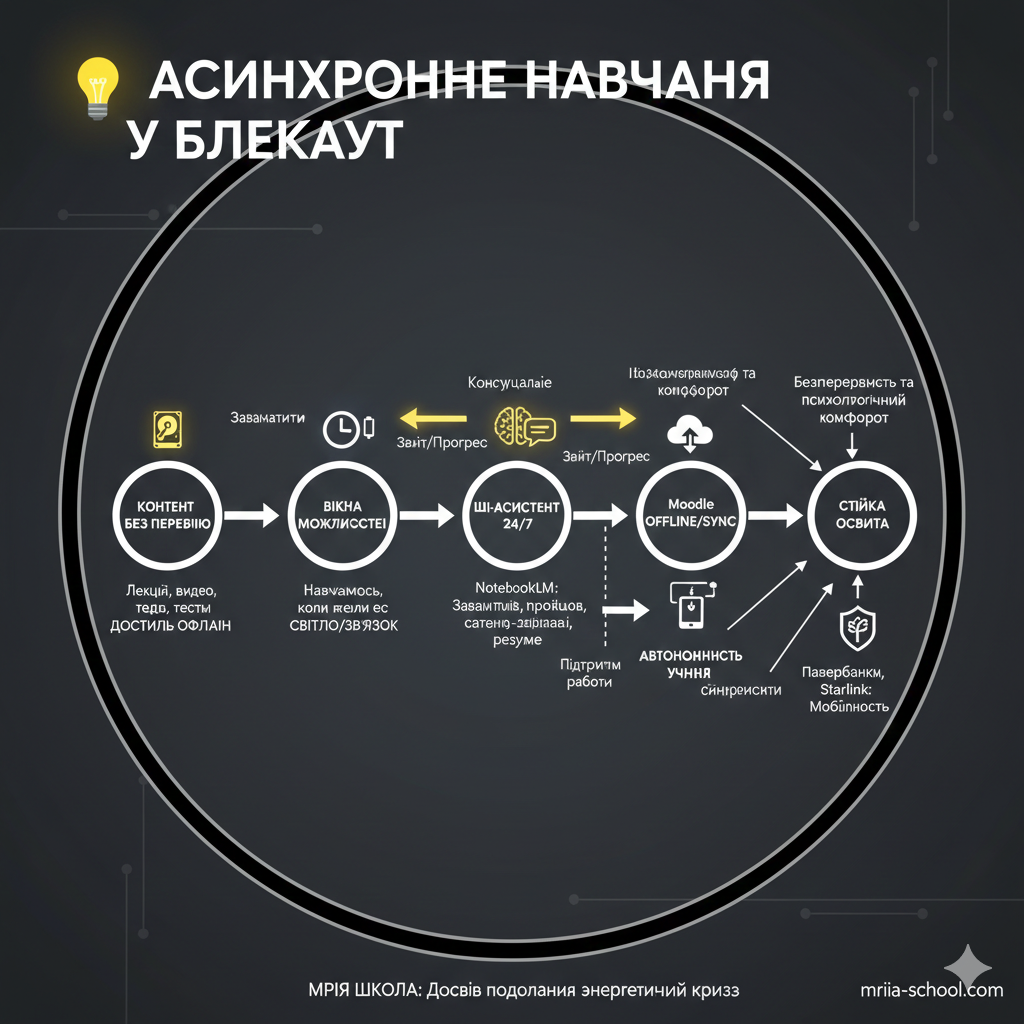
In an environment of systemic blackouts, time is no longer a linear constant; it is a fragmented resource. We introduce the concept of “educational windows”—specific periods when a student’s location has access to the grid.
Strategic Shift: Moving from a fixed 9:00 AM – 2:00 PM schedule to a “pull” model where content is consumed whenever the “window” opens.
Implementation: Lessons are designed as modular, high-impact units that can be downloaded instantly and completed offline, ensuring that the absence of a live connection does not halt academic progress.
2. Digital Autonomy and Asynchronous Resilience
Asynchrony serves as the primary guarantor of cognitive security for students. By utilizing advanced Learning Management Systems (LMS) like Moodle 5.0, we create an ecosystem of offline-first accessibility.
Infrastructure Support: Physical resilience (Generators, Starlink, and the provision of Power Banks to students) provides the hardware foundation.
Methodological Support: The curriculum is restructured into “asynchronous tracks,” allowing students to maintain their learning trajectory independently of the teacher’s current energy status.
3. AI-Driven Mentorship: Bridging the Communication Gap
One of the greatest risks of asynchronous learning is the “feedback vacuum.” When a student studies during a blackout while the teacher is offline, immediate clarification is impossible.
The AI Solution: By integrating NotebookLM, we create a digital twin of the course expertise. This AI assistant, trained on verified school materials, provides 24/7 support.
Outcome: Students receive instant explanations, summaries, and assessments, bridging the gap between independent study and expert guidance without requiring real-time human intervention.
Conclusion
The shift toward an asynchronous, resource-contingent model represents more than a temporary solution to a crisis; it is the birth of Educational Resilience. Our experience demonstrates that when the centralized power grid fails, the “light of knowledge” can remain lit through a decentralized, tech-driven approach.
By empowering students with autonomous tools—both physical (power banks) and intellectual (AI-mentors)—we foster a new generation of self-directed learners who are capable of maintaining academic excellence under extreme conditions. This model provides a blueprint for global education in an era where climate change, conflict, and infrastructure instability are becoming increasingly prevalent. The ultimate goal is to ensure that the right to education is never dictated by the status of a power switch.
1. Introduction
Online schooling has evolved from an emergency substitute to a stable educational approach in many countries, with increasing support from AI-driven systems for tutoring, assessment, analytics and student support. While these tools offer personalisation and scalability, concerns have been raised about surveillance, bias, reduced teacher autonomy, and psychosocial risks. In their large-scale systematic review of 146 studies, Zawacki-Richter et al. (2019) highlighted that much AI-driven education (AIEd) research has historically focused on technical innovation rather than pedagogical or ethical implications, and that educators remain underrepresented in design processes. In contrast, Akgun and Greenhow (2021) focused on K-12 schooling, explicitly foregrounding ethical tensions such as data protection, fairness, and the developmental vulnerability of minors, and calling for normative frameworks adapted to school contexts. This article synthesises insights from these two traditions and situates them within the operational reality of an innovative international online school, where cross-border regulation, cultural diversity and student well-being are central concerns. Early AIEd systems were largely tool-oriented, comprising intelligent tutoring systems, automated grading and learning analytics dashboards. As documented by Zawacki-Richter et al. (2019), these systems prioritised technical feasibility over pedagogical and ethical integration, often marginalising educators in decision-making processes.
Recent scholarship emphasizes that ethical governance must be embedded directly into the architecture of AI-supported online schooling rather than treated as an external regulatory layer. Systematic reviews in AIEd reveal that early deployments privileged technical optimization over pedagogical and ethical reflection, often marginalizing educators in design processes (Zawacki-Richter et al., 2019; Williamson & Eynon, 2020). In K–12 contexts, concerns surrounding privacy, fairness, learner vulnerability, and well-being have been foregrounded, prompting calls for transparent, human-in-the-loop systems (Akgun & Greenhow, 2021; UNESCO, 2021). Complementary work has highlighted the need to mitigate algorithmic bias and to ensure explainability in automated assessment and tutoring systems (Holmes et al., 2019; Yadav & Chakraborty, 2020).
Ukrainian scholars similarly stress that large-scale digitalization in schooling requires principled ethical oversight, particularly regarding surveillance, equity, and data protection (Богатирьова, 2021; Шевчук, 2020). Studies on algorithmic grading and digital assistants further underline the necessity of transparency, proportional data use, and teacher mediation in distance learning environments (Коваленко & Панченко, 2022; Кириченко, 2023). Together with international conceptual frameworks advocating educator-centered AI ecosystems (Luckin et al., 2016; Zawacki-Richter et al., 2020), this body of literature supports the development of distributed human–AI support models in which personalized student agents, teacher-facing analytic systems, and human tutors jointly uphold psychological safety, inclusion, and pedagogical authority.
However, recent advances in large language models (LLMs), multimodal AI, and agent-based architectures are enabling a transition towards more personalised, dialogical and role-specific AI agents. This shift is particularly relevant in K–12 online education, where ethical concerns such as developmental vulnerability, well-being, and fairness are amplified (Akgun & Greenhow, 2021). We argue that ethical challenges in online learning should be addressed by structuring AI roles, rather than by limiting AI capabilities. We propose that ethical challenges in online learning are best addressed not by limiting AI capabilities, but by structuring AI roles explicitly within a transparent human–AI division of labor.
References
UNESCO. (2020). Policy Brief: Education during COVID-19 and beyond. United Nations. https://www.un.org/development/desa/dspd/wp-content/uploads/sites/22/2020/08/sg_policy_brief_covid-19_and_education_august_2020.pdf
Kapp, K. M., & Defelice, R. A. (2019). Microlearning: Short and Sweet. Association for Talent Development. ISBN: 9781949036732. https://www.td.org/product/book–microlearning-short-and-sweet/111915
Zimmerman, B. J., & Schunk, D. H. (Eds.). (2001). Self-Regulated Learning and Academic Achievement: Theoretical Perspectives (2nd ed.). Routledge. DOI: https://doi.org/10.4324/9781410601032
Luckin, R., Holmes, W., Griffiths, M., & Forcier, L. B. (2016). Intelligence Unleashed: An argument for AI in Education. Pearson. ISBN: 9780992424886. https://discovery.ucl.ac.uk/1475756/
Hodges, C. B., Moore, S. L., Lockee, B. B., Trust, T., & Bond, M. A. (2020). The Difference Between Emergency Remote Teaching and Online Learning. EDUCAUSE Review. https://er.educause.edu/articles/2020/3/the-difference-between-emergency-remote-teaching-and-online-learning
Akgun, S., & Greenhow, C. (2021). Artificial intelligence in education: addressing ethical challenges in K-12 settings. AI and Ethics, 1, 431–440. https://doi.org/10.1007/s43681-021-00096-7
Zawacki-Richter, O., Marín, V. I., Bond, M., & Gouverneur, F. (2019). Systematic review of research on artificial intelligence applications in higher education: Where are the educators? International Journal of Educational Technology in Higher Education, 16(39). https://doi.org/10.1186/s41239-019-0171-0
Holmes, W., Bialik, M., & Fadel, C. (2019). Artificial Intelligence in Education: Promises and Implications for Teaching and Learning. Boston: Center for Curriculum Redesign.
Luckin, R., Holmes, W., Griffiths, M., & Forcier, L. B. (2016). Intelligence Unleashed: An Argument for AI in Education. Pearson.
Williamson, B., & Eynon, R. (2020). Historical and social contexts of AI in education. AI & Society, 35, 611–620.
Zawacki-Richter, O., et al. (2020). Ethics and AI in Higher Education: A Theoretical Framework. Educational Technology Research and Development.
Освітня стійкість: нова парадигма асинхронного навчання в умовах глобальної енергетичної кризи
В. Залізко
Міжнародний інноваційний центр штучного інтелекту, ETH
https://orcid.org/0000-0001-5362-8270
ПРАКТИЧНІ ПОРАДИ ДЛЯ ШКІЛ
Ось як ваша школа може підготуватися до можливих відключень електроенергії цієї зими. Ми зібрали рекомендації Міністерства освіти і науки України (лист № 1/24197-25 від листопада 2025 року) та розширили їх у форматі практичних порад від адміністрації школи. Пам’ятайте: головне — безпека дітей, вчителів і всіх учасників освітнього процесу. Кожен заклад має право на гнучкість завдяки академічній та організаційній автономії (стаття 23 Закону «Про освіту»).
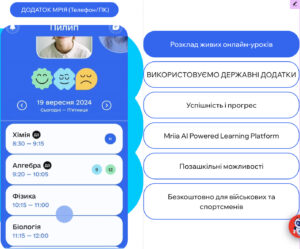
НАШ ДОДАТОК МРІЯ+ дозволяє безкоштовно учням в асинхронному режимі навчатися, а також допомогти:
- Самостійно планувати структуру навчального року та дня Ми маємо повне право визначати:
- тривалість навчального року, тижня, дня;
- кількість і тривалість уроків;
- перерви та відпочинок між заняттями;
- форми проведення занять (з урахуванням віку дітей, їхнього здоров’я, особливостей регіону та погоди). Це дозволяє нам швидко реагувати на ситуацію без очікування дозволів зверху.
- Готувати цифрову базу на випадок відключень (листопад–лютий)
- Перевіряємо, чи мають усі учні доступ до платформ: Google Classroom, Moodle, Microsoft Teams або інших LMS. Якщо ні — допомагаємо налаштувати (інструкції для батьків, гаряча лінія школи).
- Завантажуємо всі матеріали до кожного уроку наперед: конспекти, презентації, відео, завдання, тести. Робимо це вже зараз на весь зимовий період.
- Активно використовуємо безкоштовну державну платформу «Всеукраїнська школа онлайн» — там готові уроки, записані відео та інтерактивні завдання, які працюють навіть при слабкому інтернеті.
- Готувати«план Б» на папері — друкуємо все важливе
- Видаємо учням паперові підручники та робочі зошити (перевіряємо комплектність).
- Роздруковуємо або ксерокопіюємо: плани уроків, таблиці, схеми, контрольні завдання, диктанти, вправи на розвиток навичок.
- Зберігаємо запас матеріалів у школі та в учителів вдома — на випадок тривалого блекауту без інтернету та світла.
- Організовуємо консультації та підтримку учнів
- Складаємо графік очних і онлайн-консультацій для кожного вчителя (враховуємо наявність генератора/акумуляторів у школі та графік відключень у вашому районі).
- Проводимо заняття в синхронному форматі, коли є світло, або переходимо на асинхронний (учень працює самостійно за завданням, надсилає фото/відповіді пізніше).
- Виконуємо програми максимально гнучко
- Ущільнюємо матеріал там, де можливо (об’єднуємо схожі теми).
- Збільшуємо частку самостійної роботи учнів удома.
- Використовуємо проєктну діяльність, читання, творчі завдання — це легше організувати без постійного світла.
Варіанти організації навчання взимку (обираємо те, що підходить саме нам)
МОН пропонує розглянути такі рішення — ми можемо обрати одне або комбінацію:
- Перенести частину занять із листопада–лютого на червень 2026 року (крім 9-х та 11-х класів — їм не можна скорочувати програму перед ЗНО/НМТ).
- Зробити зимові канікули значно довшими — наприклад, перенести частину весняних канікул на зиму.
- Перейти на шестиденний навчальний тиждень (понеділок–субота) замість п’ятиденного — це додає більше годин без подовження дня.
- Організувати навчання у дві зміни, особливо навесні, коли світловий день довший (перша зміна рано-вранці, друга — після обіду).
- Перейти на переважно асинхронний формат: учні працюють за завданням у зручний час, надсилають результати, коли з’являється зв’язок.
Комунікація — це наше все
- Створюємо єдиний канал зв’язку: Viber/Telegram-канал школи + Google Classroom + батьківські чати класів.
- Якщо зникає мобільний зв’язок — вивішуємо оголошення на стендах біля входу до школи (розклад, зміни, інструкції).
- Налаштовуємо SMS-розсилку (якщо є можливість) або просимо батьків передавати інформацію сусідам.
- Регулярно пишемо в чати: навіть «сьогодні все за планом» або «світла немає — працюємо асинхронно».
Безпека та комфорт у школі (запас на ≥ 48 годин)
- Запас питної та технічної води (пляшки, бочки, бутильована).
- Продукти тривалого зберігання: консерви, крупи, сухарі, печиво, вода в пляшках, чай/кава для вчителів.
- Ліхтарі, power-банки, акумулятори, генератор (якщо є).
- Теплі ковдри, грілки, аптечка на випадок переохолодження.
Важливі розмови з дітьми та батьками
- Проводимо батьківські збори та класні години: пояснюємо, що буде, якщо світла не буде кілька днів.
- Обговорюємо всі сценарії разом із учителями, учнями та батьками.
- Особливу увагу приділяємо психологічній підтримці: діти відчувають стрес від невизначеності — говоримо відкрито, підтримуємо, за потреби залучаємо психологів.
Пам’ятайте: ми не можемо контролювати енергосистему, але можемо контролювати підготовку. Разом ми впораємося з будь-якою зимою. Якщо у вас є ідеї чи пропозиції — пишіть класному керівнику або адміністрації. Бережіть себе та одне одного ❤️
Створено на основі офіційних рекомендацій: лист МОН № 1/24197-25 mon.gov.ua.
International scientific journal “Artificial Intelligence in Education: Ukraine and the World”