Реалізовано перший етап ШІ-оцінювання на уроках математики та фізики (білінгвальні англійсько-українські класи)
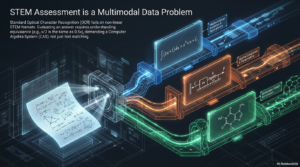
AI Assessment Beyond Correct / Incorrect
Scripta Grad — це освітня платформа на основі штучного інтелекту, розроблена Міжнародною інноваційною школою «МРІЯ» та Swiss International Innovative School (SIIS) для аналізу рукописних робіт з математики та фізики.
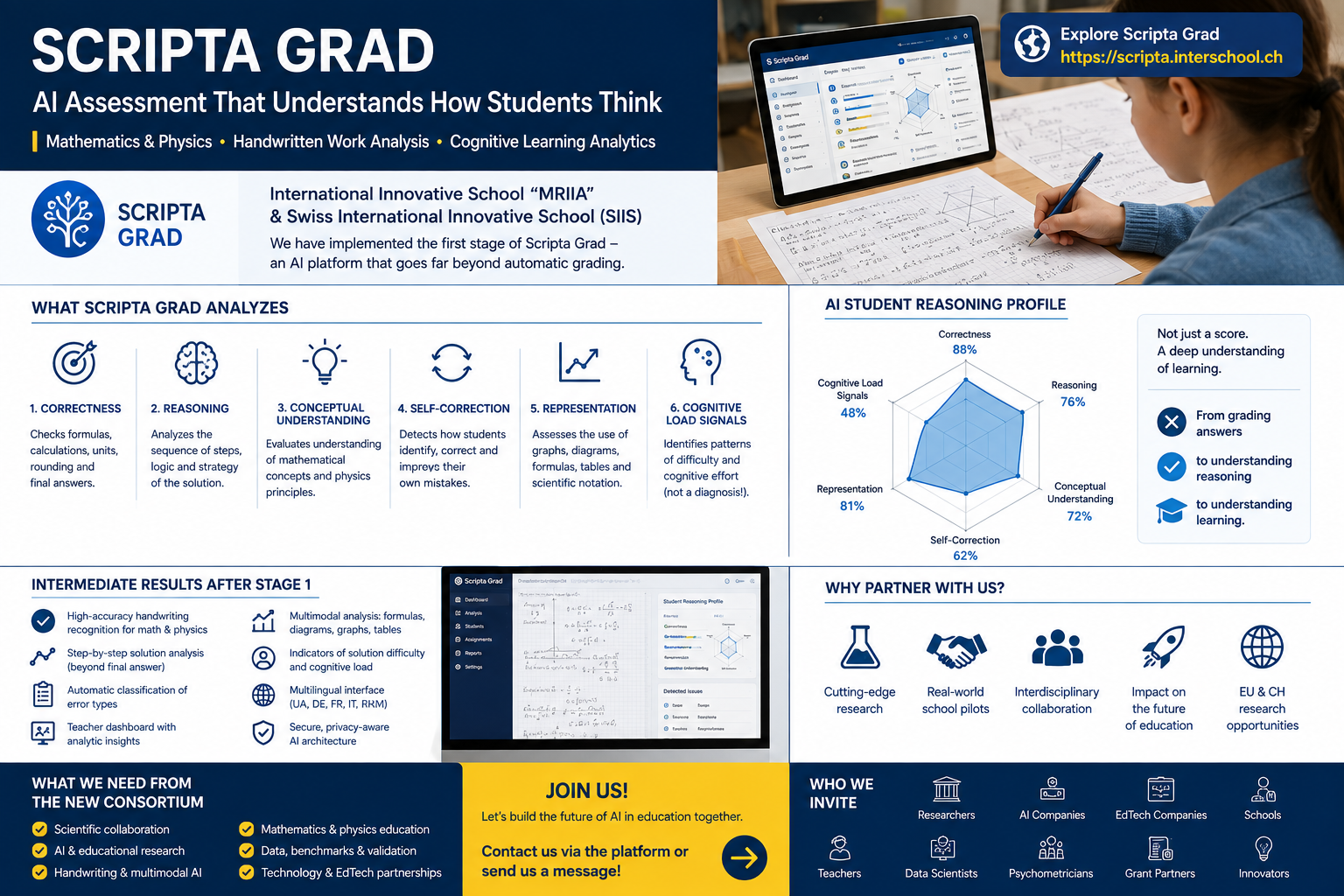
Перший етап реалізації виходить за межі традиційного оцінювання «правильно / неправильно» та зосереджується на шести вимірах: правильність, хід міркування, концептуальне розуміння, самокорекція, представлення та сигнали когнітивного навантаження.
Мета проєкту — створити пояснювану, багатомовну та орієнтовану на вчителя систему learning analytics, яка допомагає не лише оцінювати результат, а й аналізувати, як учень мислить, де виникає помилка та як змінюється його навчальна траєкторія з часом.
Ми запрошуємо університети, науковців, школи, AI- та EdTech-компанії до участі у новому міжнародному консорціумі для наукової валідації, пілотних досліджень, технологічного розвитку та спільних грантових проєктів.
Scripta Grad is an AI-powered educational platform developed by International Innovative School “MRIIA” and Swiss International Innovative School (SIIS) to analyse handwritten mathematics and physics assignments.
The first implementation stage goes beyond traditional correct/incorrect grading and focuses on six analytical dimensions: correctness, reasoning, conceptual understanding, self-correction, representation, and cognitive load signals.
The project aims to develop explainable, multilingual and teacher-centred learning analytics that can help educators understand not only whether a student is correct, but how the student thinks, where difficulties emerge, and how learning patterns develop over time.
We invite universities, researchers, schools, AI companies and EdTech partners to join a new international consortium for scientific validation, real-world pilots, technology development and joint research and grant projects.
🚀 Scripta Grad: From Automated Grading to Understanding How Students Think
Abstract
Scripta Grad is an AI-powered educational platform developed by International Innovative School “MRIIA” and Swiss International Innovative School (SIIS) to analyse handwritten mathematics and physics assignments beyond traditional correct/incorrect grading. The first implementation stage focuses on solution correctness, reasoning pathways, conceptual understanding, self-correction, mathematical representation, and indicators of cognitive difficulty. The project aims to develop explainable, multilingual and teacher-centred learning analytics capable of identifying students’ learning patterns over time. We invite universities, researchers, schools, AI and EdTech companies to join a new international consortium for scientific validation, real-world pilots, technology development and joint research projects.
Keywords: AI in Education, Learning Analytics, Mathematical Reasoning, Handwriting Recognition, Multimodal AI, Educational Assessment, Trustworthy AI.
The first implementation stage is complete — and we are now building an international research & technology consortium.
At International Innovative School “MRIIA” and Swiss International Innovative School (SIIS), we have reached an important milestone: the first implementation stage of Scripta Grad is now operational.
Scripta Grad started with a practical problem familiar to every teacher:
How can we use AI not simply to check whether an answer is correct, but to understand how a student arrived at that answer?
For mathematics and physics, this distinction is fundamental.
A student may choose the correct physical law, derive the correct equation, make one arithmetic error at the end — and receive the wrong final answer.
Another student may produce the correct number while demonstrating little understanding of the underlying concept.
A conventional automated grader can struggle to distinguish these cases.
We want Scripta Grad to do exactly that.
🎯 Stage 1 — What We Have Implemented
The first stage establishes the technological foundation for AI-supported analysis of handwritten mathematics and physics assignments.
Instead of reducing assessment to:
❌ Correct / Incorrect
we are developing a multidimensional model:
① ✅ Correctness
Analysis of:
• final answers
• intermediate calculations
• mathematical transformations
• formulas
• signs and indices
• units of measurement
• significant figures and rounding
• numerical consistency
The key principle is that a wrong final answer does not automatically mean that the entire solution is wrong.
② 🧠 Reasoning
This is one of the most important directions of Scripta Grad.
The system aims to reconstruct the solution pathway rather than analyse only the last line.
We analyse:
• sequence of reasoning steps
• logical connections between steps
• omitted intermediate steps
• chosen solution strategy
• alternative approaches
• consistency of reasoning
• transitions from formulas to numerical calculations
• whether intermediate results are used correctly later
The question changes from:
“Did the student get the answer?”
to:
“How did the student think?”
③ 💡 Conceptual Understanding
An arithmetic mistake and a conceptual misunderstanding are pedagogically very different problems.
Scripta Grad therefore aims to distinguish between:
🔹 calculation errors
🔹 algebraic errors
🔹 unit-conversion errors
🔹 transcription errors
🔹 strategic errors
🔹 conceptual misconceptions
For physics, this can include whether the student selected an appropriate physical law, interpreted variables correctly, understood vector directions and obtained a physically plausible result.
For mathematics, the analysis can address the appropriate use of mathematical concepts, transformations, functions, equations, geometrical relationships and solution methods.
④ 🔄 Self-Correction
A crossed-out formula is not necessarily “noise”.
It may contain valuable information about learning.
We therefore want to analyse whether a student:
• detects an error independently
• returns to an earlier step
• replaces an incorrect formula
• recalculates a result
• changes strategy
• checks the final answer
• verifies units or signs
• successfully recovers from an incorrect approach
This introduces a particularly interesting dimension:
metacognition.
A student who makes an error and successfully corrects it demonstrates something that a simple final-answer score cannot capture.
⑤ 📐 Representation
Mathematical and scientific thinking is not expressed through text alone.
Students think through:
formulas + symbols + graphs + diagrams + tables + drawings + vectors + annotations.
Scripta Grad therefore moves toward multimodal assessment of these representations.
Examples include:
📈 function graphs
📊 experimental graphs
📐 geometrical constructions
🧲 force diagrams
➡️ vectors
🔌 circuit diagrams
🧮 equations and transformations
📋 tables of measurements
This is especially important for physics, where the student’s diagram may reveal understanding that is not explicitly written in words.
⑥ 🧩 Cognitive Load Signals
This is one of our most experimental research directions.
Handwritten work contains information about the process of solving a problem.
Potential indicators include:
• repeated corrections
• rewriting the same calculation
• frequent changes of strategy
• fragmented page organisation
• repeated return to earlier calculations
• sudden changes in notation or writing structure
• unusually high correction density
These signals may help identify where a task became difficult for a student.
Importantly, we do not treat handwriting as a reliable method for diagnosing anxiety, stress, neurological conditions or psychological states.
These are potential learning-process and cognitive-load signals, not medical or psychological diagnoses.
📊 Intermediate Results After Stage 1
The most important result of Stage 1 is not simply another automatic grading interface.
We have established the foundation for moving from grading automation toward learning analytics.
Our current framework can be represented through six analytical dimensions:
| Dimension | What we want to understand |
|---|---|
| ✅ Correctness | Is the mathematical/physical result correct? |
| 🧠 Reasoning | How was the solution constructed? |
| 💡 Conceptual Understanding | Does the student understand the underlying concept? |
| 🔄 Self-Correction | Can the student identify and repair errors? |
| 📐 Representation | How effectively are formulas, diagrams and graphs used? |
| 🧩 Cognitive Load Signal | Where might the student have experienced increased difficulty? |
This creates the foundation for an AI Student Reasoning Profile.
Instead of:
7/10
a future teacher dashboard could provide something closer to:
Correctness — 88%
Reasoning — 76%
Conceptual Understanding — 72%
Self-Correction — 62%
Representation — 81%
Cognitive Load Signal — moderate
And, more importantly, explain why.
🔬 What We Expect From Stage 2
The next stage is considerably more ambitious.
We want to investigate whether repeated analysis of handwritten assignments can create a longitudinal learning profile.
Imagine analysing not one test, but:
20 assignments → 100 problems → one semester → several subjects.
AI could then help identify patterns such as:
📉 recurring algebraic errors
📏 systematic unit-conversion problems
🧠 strong reasoning but weak calculation accuracy
📈 improving conceptual understanding
🔄 increasing ability to self-correct
📐 strong graphical reasoning
⚠️ recurring difficulties with particular problem structures
The teacher would therefore receive not only:
“What happened in this test?”
but potentially:
“How is this student’s mathematical thinking developing over time?”
🧬 From Student Score to Student Learning Profile
Our longer-term research hypothesis is that educational assessment can become significantly more informative when AI combines three levels:
Level 1 — Answer
Was the answer correct?
↓
Level 2 — Reasoning
How was the answer obtained?
↓
Level 3 — Learning trajectory
How is the student’s reasoning changing over time?
This third level is where we see a particularly interesting research opportunity.
👩🏫 AI Should Support Teachers — Not Replace Them
This principle is fundamental to the project.
We are not developing Scripta Grad to replace professional teacher judgement.
AI can potentially:
⚡ reduce repetitive checking
🔎 identify patterns
📊 structure assessment data
🧠 analyse solution pathways
📝 generate preliminary feedback
📈 track longitudinal development
But the teacher remains responsible for the pedagogical interpretation and final assessment.
The objective is simple:
Less time checking repetitive work. More time teaching.
🌍 Why We Are Creating a Consortium
Stage 1 also showed us something important:
this problem is too interdisciplinary for one school, one research group or one company.
Reliable AI assessment of handwritten mathematical reasoning requires expertise from several fields simultaneously.
That is why MRIIA and SIIS are initiating a new research and technology consortium around Scripta Grad.
🤝 Who Are We Looking For?
We would particularly like to connect with:
🎓 Universities and research institutes working on AI, education, cognition or learning sciences.
🤖 AI research groups working on multimodal models, vision-language models, handwriting recognition, mathematical reasoning or agentic AI.
🧠 Cognitive scientists and educational psychologists interested in problem-solving, metacognition and cognitive load.
📐 Mathematics education researchers interested in analysing student reasoning and misconceptions.
⚛️ Physics education researchers interested in conceptual understanding, diagrams, models and scientific reasoning.
✍️ Handwriting / Document AI researchers working on HTR, OCR, mathematical notation recognition and document understanding.
🏫 Schools and teachers interested in running real-world pilots.
💻 EdTech companies interested in LMS integration, assessment platforms and adaptive learning.
☁️ Technology companies providing AI infrastructure, multimodal models, privacy-preserving computation or scalable inference.
📊 Data scientists and psychometricians interested in validation, reliability and longitudinal learning analytics.
🔐 Trustworthy AI researchers working on explainability, bias, privacy, fairness and human oversight.
🧪 What Do We Need From the New Consortium?
We are not looking only for sponsors.
We are looking for scientific and technological co-development partners.
There are several concrete work packages where collaboration would be particularly valuable:
🔬 Scientific validation — How accurately can AI classify mathematical and conceptual errors compared with expert teachers?
📊 Assessment methodology — How should Correctness, Reasoning, Conceptual Understanding, Self-Correction and Representation be operationalised and validated?
🧠 Cognitive research — Which observable features of written problem solving genuinely correlate with cognitive difficulty, and which should not be interpreted?
✍️ Handwriting recognition — Better recognition of handwritten formulas, symbols, diagrams, corrections and spatial relationships.
👁️ Multimodal AI — Joint interpretation of handwriting, equations, diagrams, graphs and problem statements.
📐 Mathematical reasoning — Step-level verification instead of final-answer verification.
⚛️ Physics reasoning — Analysis of models, equations, units, vectors, diagrams and physical plausibility.
🌐 Multilinguality — Building assessment pipelines across European languages and educational systems.
🔐 Trustworthy AI — Explainability, uncertainty estimation, fairness, privacy and meaningful human oversight.
🏫 Real-world validation — Controlled pilots with teachers and students in authentic classroom environments.
🇪🇺 A Multilingual Direction
Education in Europe is inherently multilingual.
For this reason, we are already designing the conceptual interface around multiple languages, including:
🇺🇦 Ukrainian
🇩🇪 German
🇫🇷 French
🇮🇹 Italian
🇨🇭 Rumantsch
The long-term objective is not simply translation.
It is to investigate whether the same underlying reasoning model can operate across languages, curricula and educational systems.
That could become an interesting research question in itself.
🎯 Expected Outcomes
Through the next stages and the consortium, we would like to work toward:
🔹 validated AI-assisted assessment criteria
🔹 explainable step-by-step analysis of mathematical solutions
🔹 automatic classification of error types
🔹 multimodal analysis of formulas, handwriting, graphs and diagrams
🔹 teacher-facing learning analytics dashboards
🔹 longitudinal student reasoning profiles
🔹 personalised formative feedback
🔹 multilingual assessment
🔹 LMS/API integration
🔹 privacy-aware educational AI architecture
🔹 real-world school pilots
🔹 benchmark datasets and evaluation protocols
🔹 joint scientific publications
🔹 joint European and Swiss grant proposals
And ultimately:
an AI system that does not merely grade student work, but helps teachers understand learning.
🚀 An Open Invitation
Stage 1 is implemented. Now we want to build Stage 2 together.
International Innovative School MRIIA and Swiss International Innovative School (SIIS) invite researchers, universities, schools, AI laboratories and technology companies to join us.
We are open to:
🤝 research partnerships
🧪 pilot studies
📚 joint publications
🇨🇭 Swiss research projects
🇪🇺 European research consortia
💶 joint grant applications
💻 technology partnerships
🏫 school pilots
📊 dataset and benchmark development
🎓 Master’s / PhD / postdoctoral research projects
If your team works on AI + Education + Mathematical Reasoning + Multimodal Learning Analytics, we would be very interested in hearing from you.
🌐 Explore Scripta Grad and contact us
Scripta Grad
From grading answers → to understanding reasoning → to understanding learning.
MRIIA × SIIS
#ArtificialIntelligence #AIinEducation #EdTech #LearningAnalytics #MultimodalAI #MathematicalReasoning #MathematicsEducation #PhysicsEducation #HandwritingRecognition #DocumentAI #CognitiveScience #TrustworthyAI #ExplainableAI #EducationalAssessment #ResearchCollaboration #EuropeanResearch #SwissResearch #ScriptaGrad #MRIIA #SIIS